4,281Total complaints
215Flagged for review
20.3% of all 1,060 flagged records in this dataset are associated with Synchrony. Its within-company flagged rate is 5.02%.
From 99,898 consumer complaints to a focused queue of 1,060 records flagged for review.
I built a complaint review application in Palantir Foundry, connecting a repeatable data pipeline, Complaint objects, two Workshop views, and embedded AIP Analyst.
The data comes from the Consumer Financial Protection Bureau (CFPB): approximately six months of 2026 complaints across the United States, covering credit cards, checking or savings accounts, and money transfer, virtual currency, or money services.
Explore the Foundry build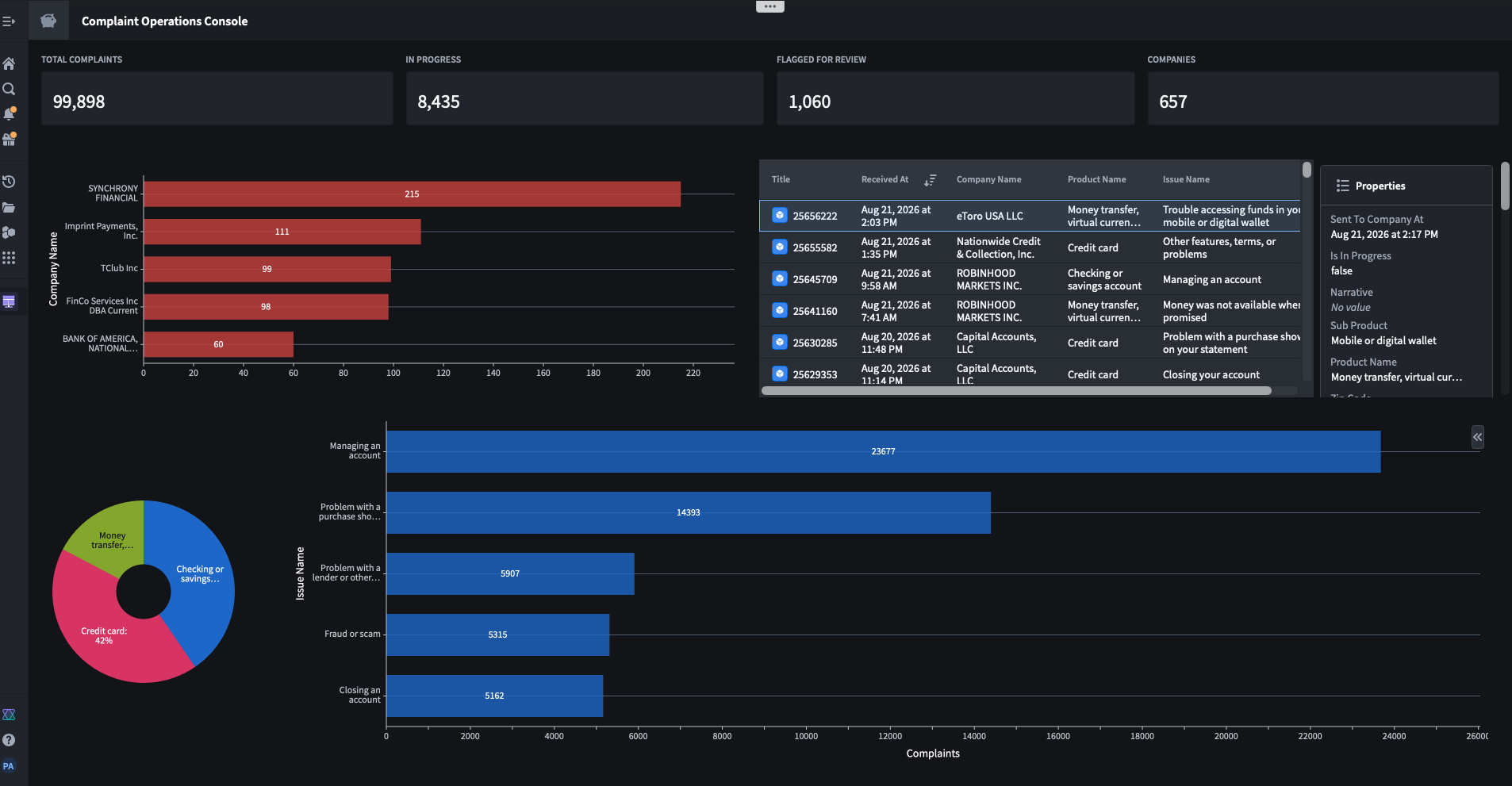
The application above runs on a Palantir Foundry developer-tier instance behind authentication. Foundry has no route to hosting a Workshop app publicly — its Public Applications feature requires a separately built Ontology SDK frontend and an Information Security Officer approval within the enrollment, neither of which exists on a developer tier.
So I rebuilt it in Python. Same data, same review rule, same two views — the
99,898 complaints, the 1,060 flagged on CFPB's Timely response? = No, and
the company view with its rate compared against the 1.06% baseline. It runs on the
same pipeline
that feeds the Foundry build.
There is no ontology here. The Foundry version models Complaint, Company and Issue as object types with link traversals, so selecting a company walks the graph and every widget follows from one object set. This version filters a dataframe. The output looks similar; the mechanism is the thing the Foundry project was built to demonstrate, and it isn't reproduced.
It is a companion to that project, and it is labelled as one — not a stand-in.
A complaint operations team needs both a place to start and the context to investigate. A national export contains useful signals, but an operator still has to move from aggregate counts to an individual complaint.
I designed this prototype around that transition: start with the overall picture, narrow the review queue, then select a company to inspect its complaint history, response mix, and flagged count. Embedded AIP Analyst supports follow-up questions against the complaint data.
Make the reason for review visible.
Keep the complaint behind it within reach.
Capital One has the most complaints in this export. Synchrony has the most flagged records. The company view makes both measures visible, with the received-date trend and response breakdown alongside them.
20.3% of all 1,060 flagged records in this dataset are associated with Synchrony. Its within-company flagged rate is 5.02%.
The largest complaint volume in this export, with zero records meeting the untimely-response rule. Volume alone does not determine inclusion in the queue.
Counts verified against the source CSV. These are snapshot observations, not a ranking of company quality or a claim about future risk.
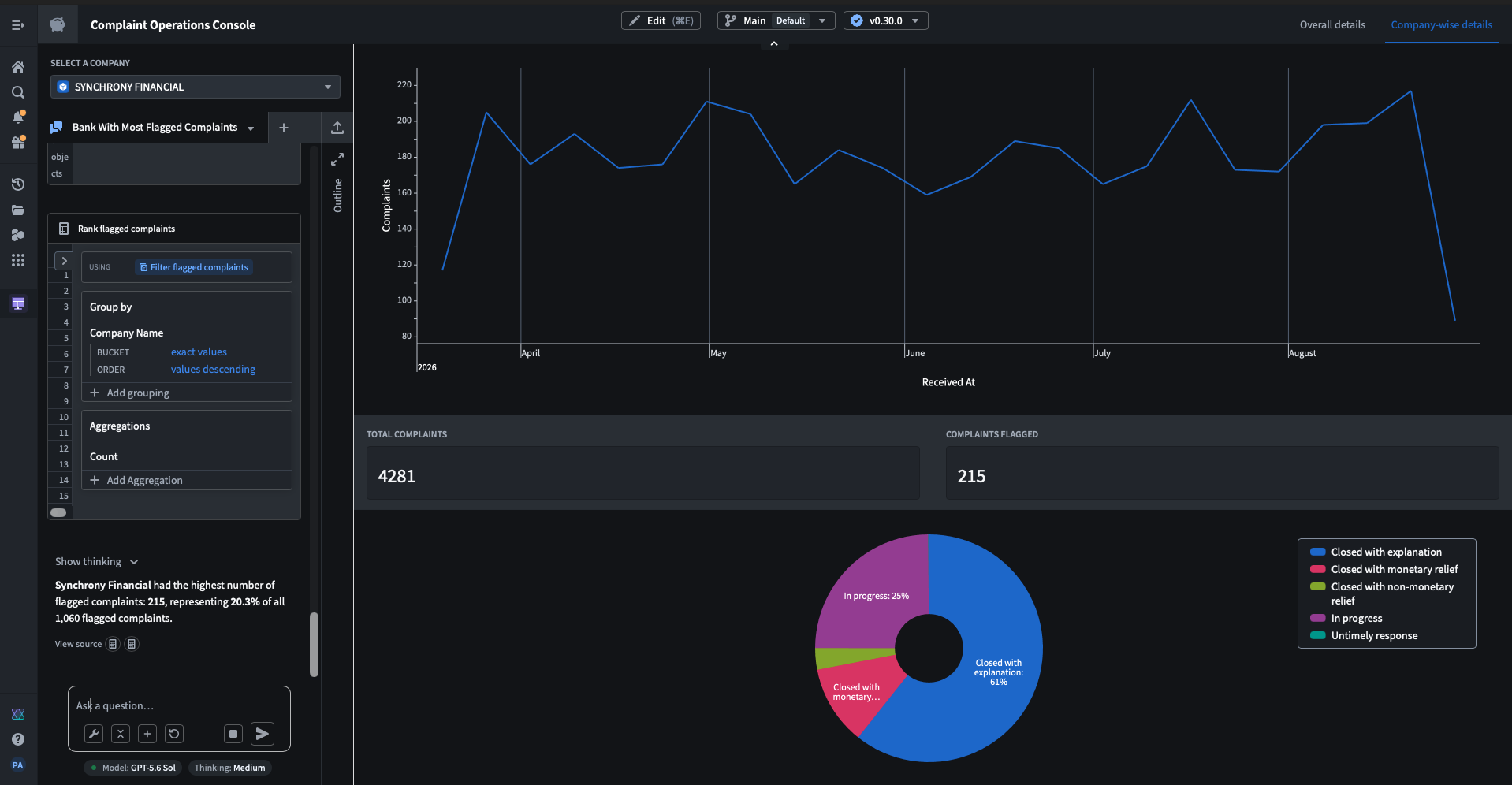
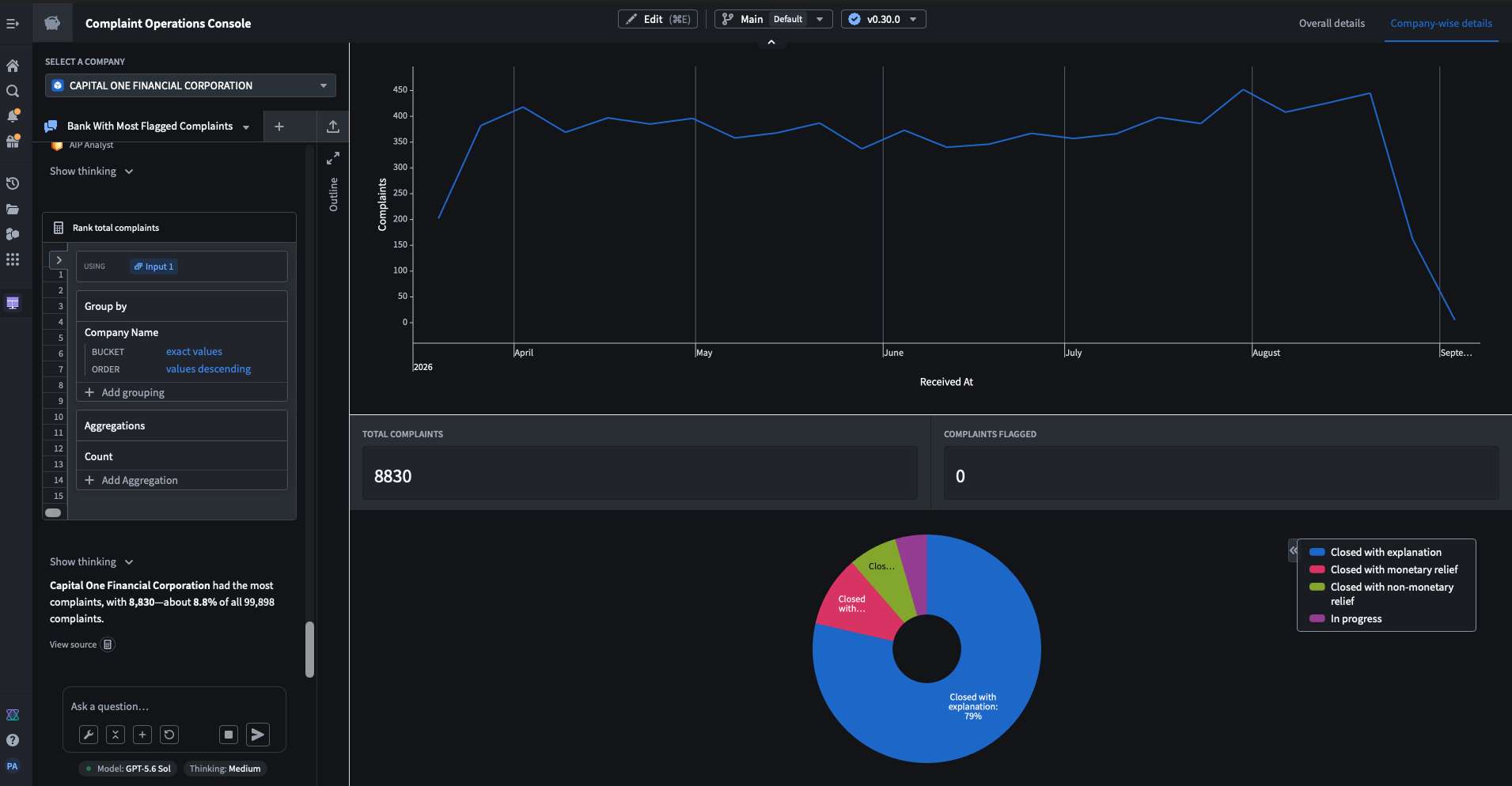
I embedded Palantir’s AIP Analyst widget in Workshop so a reviewer can ask questions about the complaint data. The examples show company grouping, record-count aggregation, and source links beside the generated answer.
The selected company controls the company view. The illustrated AIP analyses compare companies across their own input object sets; their scope should be checked separately.
About the AIP Analyst widget ↗99,898 records
16 source columns
Cleaned dataset
18 output columns
Unique complaint ID
Typed properties
Two operational views
Embedded AIP Analyst
I standardized column names, converted complaint IDs to strings, updated legacy date types, and replaced literal “None” placeholders with nulls in five fields. Two Boolean rules identify untimely responses and records reported in progress.
I backed the Complaint object type with complaints_clean, using complaint_id as its primary key and title. Company, product, issue, response, and narrative remain properties of the same complaint.
I built Overall details and Company-wise details views. Queue filters, a company selector, linked metrics, time-series and response charts, and complaint properties support progressively closer inspection. I embedded AIP Analyst for natural-language questions and inspectable aggregations.
I used three CFPB product categories across the United States: credit card; checking or savings account; and money transfer, virtual currency, or money service. Credit reporting and mortgages are outside this export’s scope.
69.17% of records have no public narrative. I preserved those complaints because their structured properties still support review. The detail view can use the 30,798 narratives that are available.
The review rule uses the published “Timely response?” field. The date a complaint was sent to a company measures routing, not response time. “Flagged” means historically untimely; it does not mean the complaint is currently unresolved.
An explainable queue of 1,060 complaints, with the underlying records available for inspection.
The project demonstrates a complete Foundry path: ingest, transform, model, explore, and ask follow-up questions with AIP Analyst. The counts describe this data snapshot; this prototype has not been evaluated for time savings or resolution outcomes in a live operations team.
Add Company, Product, Issue, and State object links; introduce Review Cases with ownership and status Actions; then extend the existing time-series charts with baseline comparisons and alerts that account for publication delays.
Source: Consumer Financial Protection Bureau (CFPB), Consumer Complaint Database. This nationwide extract covers approximately six months of 2026: received dates March 18–September 1, 2026 (UTC), exported September 6, 2026. It includes credit card; checking or savings account; and money transfer, virtual currency, or money service complaints across the United States. Public complaint records are not a representative measure of customer experience; company counts should not be treated as market-share-adjusted comparisons.